
A book for everyone
The SevenLights
The seven laws given to all of humanity. Not to a nation, not to a religion. To everyone, from the beginning.
All seven, in plain English
Here they are.Nothing is held back.
Six of them ask you to stop. The seventh asks you to build. That shape is the whole teaching, and you have now seen it.
- 1
Recognise the One G‑d, and worship nothing else
There is one G‑d who made everything, and nothing inside the world is to be served as though it made you.
עבודה זרהAvodah Zarahforeign service - 2
Treat the Name of G‑d with reverence
The Name of G‑d is not to be used as a weapon, a curse, or a throwaway, and reverence in speech is the first place reverence becomes real.
ברכת השםBirkas Hashemblessing the Name - 3
Do not murder
A human life is not yours to take, because a human being is not a thing that belongs to anyone.
שפיכות דמיםShefichus Damimspilling of blood - 4
Guard the boundaries of sex and family
There are lines around sex, and they exist so that a household can be a place a child is safe to arrive into.
גילוי עריותGilui Arayosuncovering nakedness - 5
Do not steal
What is not yours stays not yours, whether you take it by force, by stealth, by contract, or by simply never paying for it.
גזלGezelrobbery - 6
Do not eat flesh torn from a living animal
You may eat meat, and you may not tear it from an animal that is still alive.
אבר מן החיEiver Min HaChaia limb from the living - 7
Establish courts of justice
Every society is obliged to set up real courts, so that the other six are not merely opinions.
דיניםDinimjudgments
The shape of the seven
Six lamps turnedtoward one.
Read them again and you will notice something. Six of the seven are refusals. Do not worship it, do not curse with it, do not kill, do not take, do not tear. Only the seventh asks a society to make something that was not there before: courts, where a wrong can be brought and heard and decided.
A world is not built by refusals. The six clear a space. The seventh stands up inside it.
The six turn as you scroll. The seventh brightens.
Where they come from
One verse.Seven laws.
All seven are read out of a single sentence, spoken to the first human being, in a garden, about what he was allowed to eat. The Talmud takes the verse apart clause by clause, and each clause yields one of the seven.
וַיְצַו ה׳ אֱלֹקִים עַל הָאָדָם לֵאמֹר מִכֹּל עֵץ הַגָּן אָכֹל תֹּאכֵל
vayetzav Hashem Elokim al ha'adam leimor, mikol etz hagan achol tochel
And the L-rd G‑d commanded the man, saying: of every tree of the garden you may surely eat.
Look at what has happened there. The entire constitution of humanity, the law of the courtroom and the law of the bedroom and the law of the butcher's block, has been found inside one sentence spoken to one man, alone, about fruit.
Why any of it matters
It was never aboutbeing good.
The tradition says the world was made because G‑d wanted a home in the lowest place. Everything in the seven laws is the construction of that home, and it is built from underneath.
A light without limit
The tradition begins not with a world but with light, and with a desire: that there be a dwelling in the lowest place. Not a visit. A dwelling.
A withdrawal that makes room
The first act was a contraction. The light drew back, and what remained was a hollow with an impression left in it. Nothing can be placed into a space that is already full.
Six walls, and a space in the shape of a room
Six of the seven laws are restraints. They build no hospital and feed nobody. What they do is empty out the space a person's appetite would otherwise fill completely.
The seventh raises the walls
Courts of justice. The only one of the seven that asks a society to construct something, because a room is made by what is kept out and then by what is raised inside it.
And it lands on a table
The whole descent terminates on a plate, in the hand of somebody who is hungry and who nevertheless waits. That is where the dwelling is either built or it is not.
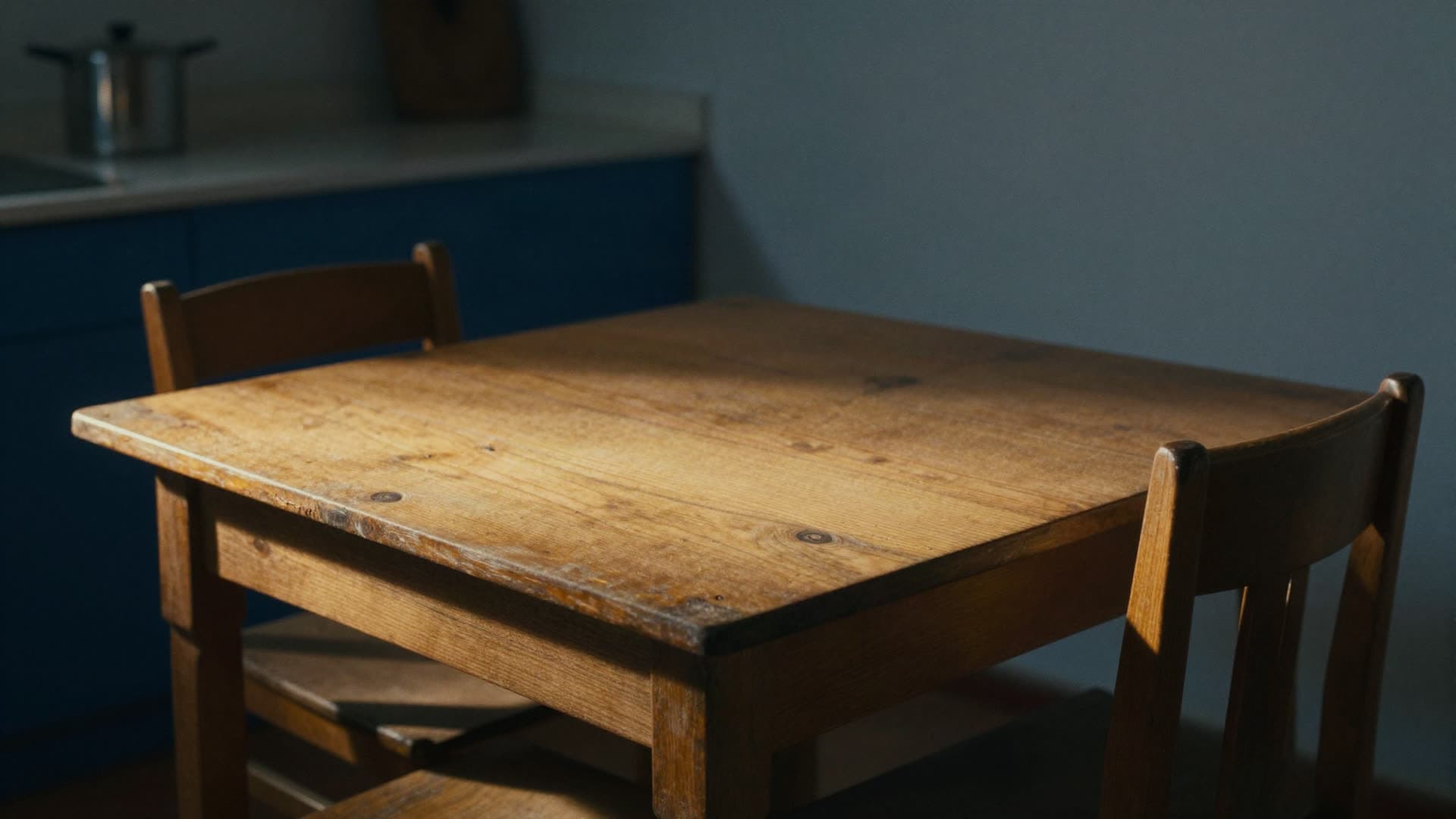
Two rooms, identical.
In each one, the same table, the same chairs, the same bread and the same cloth. In the first, a person has arranged the room to please themselves. In the second, a person has prepared the room because a guest is coming.
Every detail is the same. Only one of them is a home, and the difference is not in the room. It is in whether the room is turned toward someone.
That is why the tradition insists these seven were commanded rather than merely reasoned out. Not for the credit of obedience. For the orientation of the room.
Start at the beginning.
Five minutes, no background assumed, no Hebrew required. It will tell you what these are, where they came from, and what to do on Monday.