Law 5 of seven, a restraint
Do not steal
This law is derived from the most surprising place in the verse. Not from a prohibition, but from the words of permission: of every tree of the garden you may eat. The tradition reads the sentence that grants as the sentence that limits.
OneIn one sentence
What is not yours stays not yours, whether you take it by force, by stealth, by contract, or by simply never paying for it.
robbery
גזלGezel
Taking what belongs to someone else. Hebrew has two words here: gezel, taking openly, and geneivah, taking in secret. The law is named for the open one.
TwoWhere it comes from
All seven laws are read out of a single verse spoken to the first human being. This one is found in the words מִכֹּל עֵץ הַגָּן mikol etz hagan, which mean of every tree of the garden, in Bereishis 2:16.
The Talmud finds the prohibition of theft in the clause of permission. Adam is told which trees are his. That sentence is the reason there is such a thing as a tree that is not his, and therefore the reason there is such a thing as theft.
The Rambam counts this among the seven, and his treatment in the same chapter reaches into ordinary commercial life: withholding a worker's wages, and taking something of very small value, are inside this law and not beside it.
Cited: Bereishis 2:16; Sanhedrin 56b; Rambam, Hilchos Melachim 9:1. Every reference on this site is listed in full, with its status, on the sources page.
ThreeWhat it actually asks of you
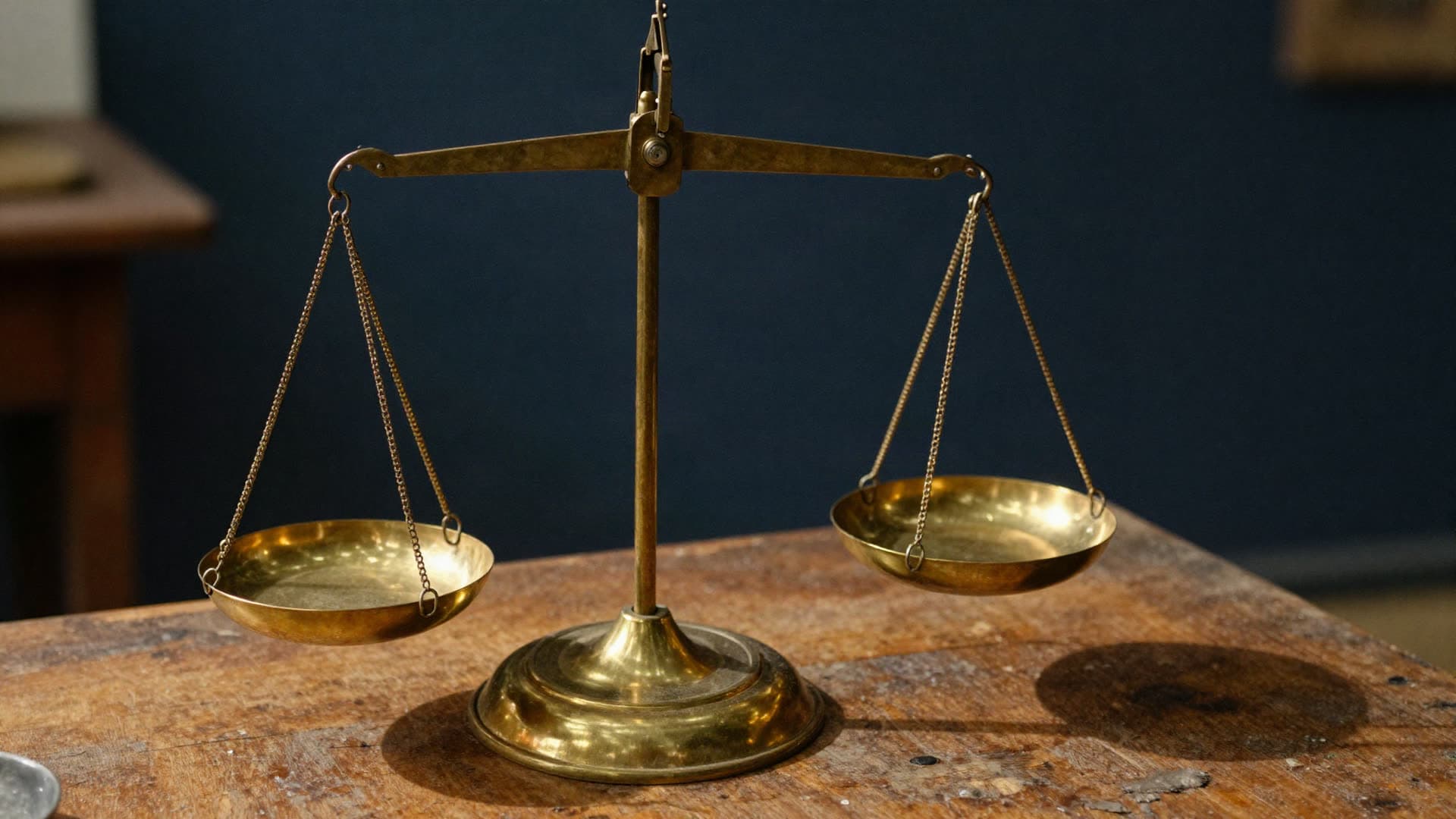
That the scale be accurate on the day nobody is looking.
This law lives in weights, invoices, hours billed, materials specified, and the difference between what was promised and what was delivered. Most theft is not dramatic. It is a rounding, repeated.
That a worker be paid.
On time, in full, including the person with no leverage to chase it. The tradition treats delayed wages as a live wrong rather than an administrative delay, because the person waiting is usually the person who cannot wait.
That small amounts count.
The Rambam's ruling reaches a value below the threshold at which a court would act. The law does not scale with the amount. It scales with whether it is yours.
That you notice what you take without a transaction.
Attention, credit, someone's work presented as your own, a reputation borrowed against. Not all of these are theft in a court. All of them are the same motion of the hand.
FourWhat it does not ask of you
It does not condemn owning things.
Property is not a concession in this system. It is the thing the law is built to make possible. The first sentence about the trees is a grant.
It does not condemn profit.
Trade, wages, margin and wealth are not the subject. An accurate scale is the subject. A merchant with a true scale and a large business has kept this law completely.
It does not ask you to be poor.
There is no suggestion anywhere in the seven that having less is holier. The tradition's picture of the world to come, in the Rambam's own words, is one of abundance, not of scarcity.
It does not resolve your legal dispute.
Who owes what, in a real disagreement, is what the seventh law builds courts for. This law tells you what to do while the court decides: do not take it in the meantime.
FiveThe deeper layer
The deeper layer
Everything above is the plain law. What follows is the inner tradition's reading of it, and it never replaces what came first.
Take the derivation seriously for a moment. Theft is learned from a sentence of permission. Remove the sentence and you have not made everything free; you have removed the category of ownership, and with it the category of theft, and with it the possibility of honesty.
A permission is not the absence of law. It is the opening line of the law.
The Talmud extends this into something startling: one who takes enjoyment from this world without a blessing is described as one who steals. Steals from whom? From the Owner, whose permission is the only reason the fruit was ever in your hand. On that reading, the entire world is the garden, everything in it is under a grant, and the question at every meal is whether you know that you have been given something or think you have simply arrived at it.
SixOne practice this week
Correct one small figure.
Find one number this week that is quietly in your favour and should not be: an hour billed that was not worked, an expense that was not really that, a refund you were given twice, something borrowed a year ago. Correct it, and notice how much of the resistance is about the amount and how much is about the admission.
SevenQuestions people ask
Is downloading something without paying theft?
The tradition would ask you the same question it asks about a scale: was it yours to take. Whether a given case is legally gezel is a real question in Jewish law and depends on details. What is not in doubt is which direction the law leans when you are the one deciding in your own favour.
What about a tiny amount?
The Rambam's ruling explicitly reaches below the amount a court would bother with. That is the point of including it: the law is not a threshold, it is a boundary.
Someone stole from me. What does this law say about that?
It says they were wrong, and the seventh law says there should be somewhere you can take it. This law does not ask you to absorb the loss quietly. It asks you not to become the next person taking something.
What if I cannot return it?
That is exactly the case Jewish law has worked out in detail: what to do when the owner is unknown, unreachable, or dead. There are answers. Ask a rabbi rather than deciding that the impossibility of a perfect repair means nothing is owed.
This site does not rule on Jewish law and cannot answer a question about your own situation. The about page says how to find someone who can.
Where this sits
- 1Recognise the One G-d, and worship nothing else
- 2Treat the Name of G-d with reverence
- 3Do not murder
- 4Guard the boundaries of sex and family
- 5Do not steal
- 6Do not eat flesh torn from a living animal
- 7Establish courts of justice
Six restraints and one construction. Law seven is the only one that asks a society to build something, and the other six clear the ground it stands on.